
The Email Step: Capturing Leads in a Quiz Funnel Without Killing Completions
The email step is the most contested slide in any quiz funnel. Place it wrong and you torch the completions you paid for; skip it entirely and every shopper who doesn't buy today vanishes without a trace. Get it right and the quiz becomes the best list-builder a DTC brand can run — because it doesn't just capture an address, it captures an address attached to everything that person just told you.
📍 Where the gate goes
The placement logic is direct response arithmetic: ask when perceived value is highest and remaining effort is lowest.
- Too early (slide one or two): you're a stranger demanding an email for nothing. This is the popup problem wearing a quiz costume.
- Too late (after the result): the shopper already has the answer — most have no further reason to trade for it. You'll capture almost no one you weren't converting anyway.
- The pocket: after the last question, before the result. The shopper has invested every tap they're going to invest, the result is right there, and the email is the last step between them and it. Value built, payoff pending.
That's also the placement that keeps the trade honest: they're exchanging an email for something real — their personalized result — not for vague future newsletters.
🤝 Making the trade fair
A gate converts in proportion to how fair the exchange feels. Three rules:
- Name the payoff. "Enter your email and we'll show your match" — the result is the incentive. Sweeteners (a first-order code, a guide matched to their result) can raise opt-in, but the result itself is the core of the trade.
- Say what happens next, truthfully. One line: where the results go, what you'll send. If they're entering a flow, don't pretend they aren't — shoppers know how email works, and honesty here costs you nothing but the subscribers who'd have unsubscribed angrily anyway.
- Ask for the minimum. Email. Maybe a first name if your flows genuinely use it. Every extra field is a completion tax — phone numbers especially, so ask for one only if SMS is a real part of your follow-up, and make that ask honest too.
🔀 Should shoppers be able to skip?
The honest answer: it's a real tradeoff, and the right call depends on what the traffic cost you.
Case for a skip option: shoppers who'd abandon at a hard gate still reach your result page — and a result-page conversion is worth more than a dead email. On expensive paid traffic, letting a buyer through to buy is rarely the wrong move.
Case for a hard gate: unambiguous list growth, and a cleaner read on your economics per lead. If your follow-up flows are strong, the lifetime value of the captured email can outweigh the completions lost at the gate.
Whichever you pick, measure it — the gate is a slide like any other, and its drop-off shows up in per-question analytics right next to the rest. If the gate is your funnel's biggest leak, the data will say so, and you can test softer copy, a sweetener, or a skip link and watch the number move. (Quiz funnel metrics covers how to read the whole board.)
📬 The part most brands waste: the answers
Here's what separates a quiz email from a popup email: the popup tells you someone exists; the quiz tells you who they are.
Every address you capture arrives with a full answer profile — their problem, their goal, their situation, and which result they landed on. Piped into your ESP (QuizLanding syncs to Shopify customer tags and on to Klaviyo), that turns generic flows into personal ones:
- Welcome flow, split by result. The "dry skin" path gets a different email one than the "oily skin" path — same flow structure, matched content.
- Abandonment recovery with a reason. "Your match is still here — and based on what you told us, here's why it fits" beats a generic reminder, because it re-opens the exact loop the quiz built.
- Product education keyed to their problem. They told you what they're dealing with; your emails can teach to it instead of broadcasting at it.
This is zero-party data doing its actual job. Most brands capture it and then send everyone the same three emails — which is like taking notes in a sales call and then reading a script anyway.
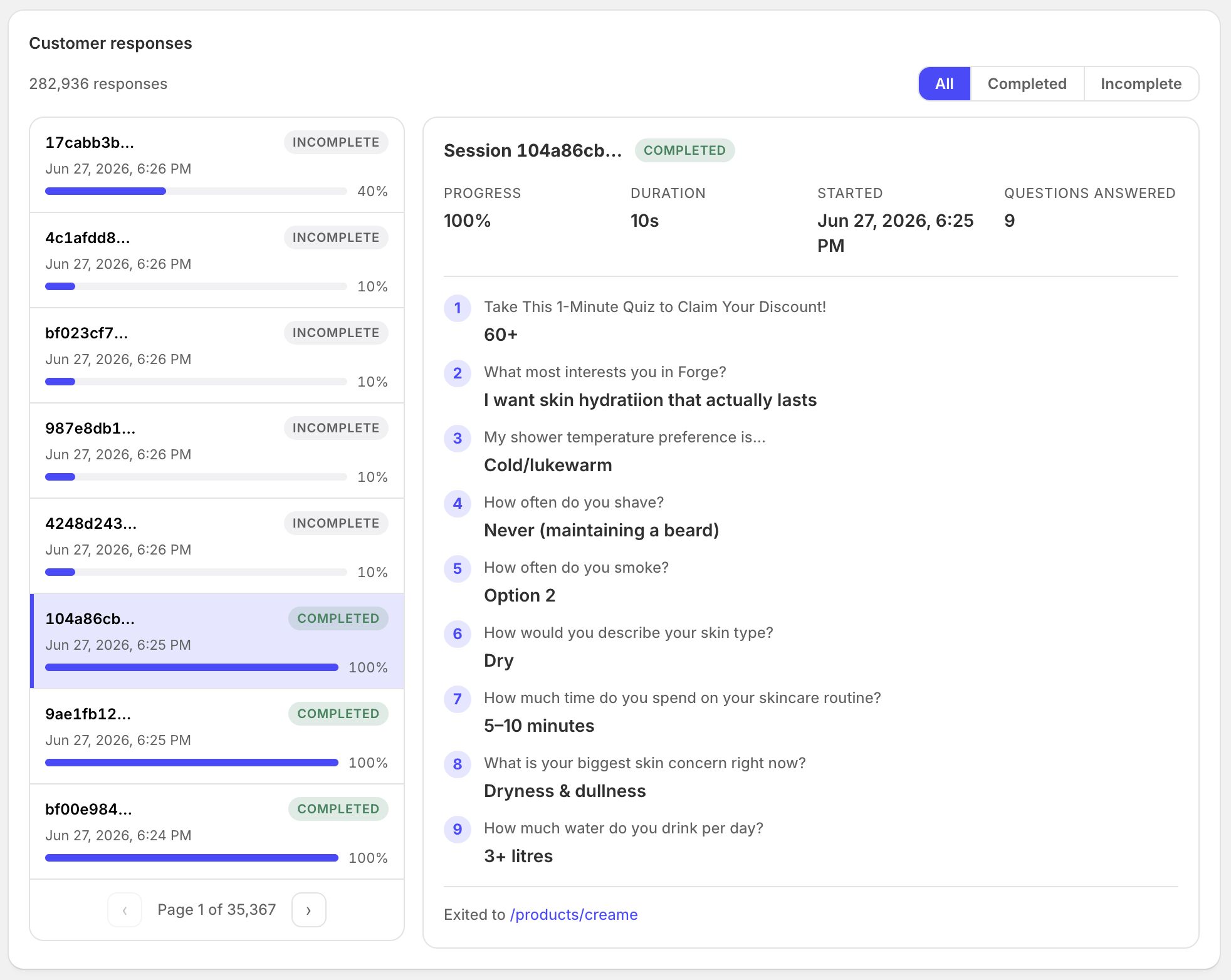
Every captured lead comes with its full answer profile — the raw material for flows that read like they were written for one person.
🚪 What about the ones who leave anyway?
Even a well-placed gate loses people, and partial responses are still signal. Seeing where non-finishers exited — and what they answered before leaving — tells you whether you're losing casual clickers at slide two (an ad-match issue) or nearly-done shoppers at the gate (a trade-fairness issue). Those are different problems with different fixes, and only answer-level data tells them apart.
❓ Frequently asked questions
What's a good opt-in rate at the gate?
Rates vary too much with traffic source and offer to bless a universal number — cold clicks and warm on-store browsers behave differently. The dependable method: baseline your own gate, change one thing (copy, sweetener, skip option), and compare. Your trend line beats anyone's benchmark.
Won't a gate feel pushy after a friendly quiz?
Only if the copy swerves into pushiness. A plain, fair trade — "pop your email in and your results are on the way to you too" — reads as the natural next step of the conversation. It's the bait-and-switch gates, vague about what happens next, that feel like a betrayal.
Should the result also be emailed?
Yes — it's honest (you said you would), useful (results get revisited on a second device, later, calmer), and it gives email one of the highest-open sends you'll ever have: a message the recipient explicitly asked for.
Does this work without a big email operation?
A single welcome flow split by quiz result is already ahead of most popup-fed lists. Start there; sophistication can come later, but segmentation-by-answers is available on day one.
✅ The takeaway
Gate after the questions, before the result. Trade fairly and say so plainly. Decide on skip based on what your traffic costs and what your flows recover — and measure the gate like any other slide. Then actually use the answers, because that's the entire point: a quiz doesn't just build a bigger list, it builds the only kind of list where you already know what every subscriber wants.
Keep reading: the result page guide, quiz funnels for Meta ads, and common quiz funnel mistakes.
Want a quiz funnel live on your Shopify store this week? QuizLanding drafts your quiz with AI, hosts it natively on your store, and pairs full analytics with an AI assistant that tells you what to improve — all in one flat plan. Start for free.