
10 Quiz Funnel Mistakes That Quietly Kill Conversion (and the Fix for Each)
Most underperforming quiz funnels aren't broken in some mysterious way — they're making one or two of the same ten mistakes everyone makes, and each mistake has a known fix. This is the checklist we'd run any DTC quiz through before touching ad spend: ten leaks, in the order shoppers meet them, with the repair for each.
🚪 Mistakes at the opening
1. A first question that asks too much
Budget, email, phone, or anything requiring self-reflection as question one. The shopper hasn't decided to take the quiz yet — the first tap is what decides them.
Fix: open with an easy, visual, zero-stakes question a stranger can answer in two seconds. The first question's only job is getting the second one answered — the full question-writing rules are here.
2. A quiz that ignores the ad that sent the click
The ad promises "find your sleeper type," the quiz opens with "Welcome! What's your age range?" The thread snaps, and so does the visit.
Fix: write the ad and the first slide as one piece of copy, and give each ad angle its own quiz variant. The Meta ads guide covers the chain in full.
🧱 Mistakes in the middle
3. Questions that don't do anything
Every question should either change the recommendation or become part of its justification. Questions that do neither — demographic curiosity, "research" items — are pure completion tax.
Fix: run the two-jobs test on every slide and delete the failures. Deleting a question is the highest-ROI edit in quiz optimization.
4. Catalog language instead of customer language
"Select your preferred formulation" assumes the shopper knows your product line. They don't — that's why they're in a quiz.
Fix: ask about their life ("How does your skin feel by mid-afternoon?") and let your routing logic do the translating. The translation is the product.
5. The email gate in the wrong place — or with an unfair trade
A gate on slide two is a stranger demanding payment for nothing; a vague gate ("subscribe for updates!") right before the result is a bait-and-switch smell at the worst moment.
Fix: gate after the last question, before the result, with an explicit fair trade — "enter your email, get your results" — and honest copy about what you'll send. The email step deserves its own strategy.
🎁 Mistakes at the payoff
6. The twelve-product "result"
A grid of vaguely-related products is not a result — it's the collection page with extra steps, and it returns the exact choice overload the quiz promised to remove.
Fix: one hero recommendation, one or two clearly-subordinate alternates at most. Committing to an answer is the format's whole value.
7. A match with no "because"
A product appears; no line connects it to anything the shopper said. Without the reason, the recommendation feels random — and random feels like a trick that wastes every question that came before it.
Fix: restate their answers, then justify the match in one concrete paragraph: you told us X and Y, this fits because Z. The result page anatomy walks through all five parts.
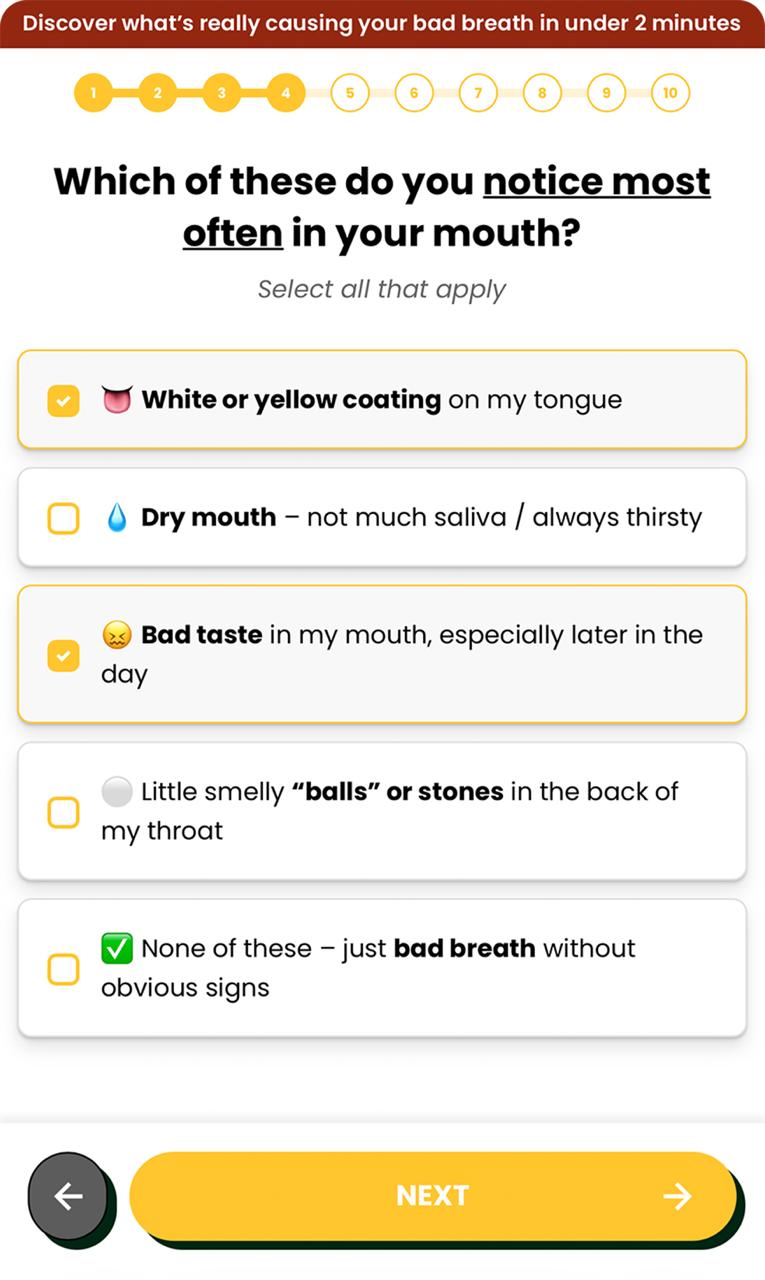
The payoff done right: one hero, a reason built from the shopper's own answers, one CTA.
8. A hard-sell swerve after a helpful conversation
Six friendly questions, then a wall of countdown timers and pressure. The tonal betrayal costs more than the tactics gain — the trust the quiz built was the asset, and this spends it.
Fix: sell confidently in the same voice that asked the questions. Proof and a clear offer, honestly framed, land harder here than pressure ever will — the shopper asked for this recommendation.
⚙️ Mistakes in the operation
9. Hosting the quiz off your store
An external quiz URL adds a domain hop, a second loading experience, and generic branding at the exact moment trust matters most — and your funnel data ends up living on someone else's page.
Fix: host natively on your own domain, in your own theme. On Shopify that's an install, not a project — it's the approach QuizLanding is built around, and the native vs. external tradeoffs are detailed here.
10. Launch and forget
The quiz ships, weeks pass, nobody looks at which slide is bleeding shoppers. The first version of any quiz is a hypothesis — treating it as finished forfeits the format's biggest advantage: it tells you where it's broken.
Fix: a weekly five-minute loop — check per-question drop-off, fix the single biggest leak, re-measure. The metrics guide is the playbook; QuizLanding's AI assistant will even read the data and name the fix for you.
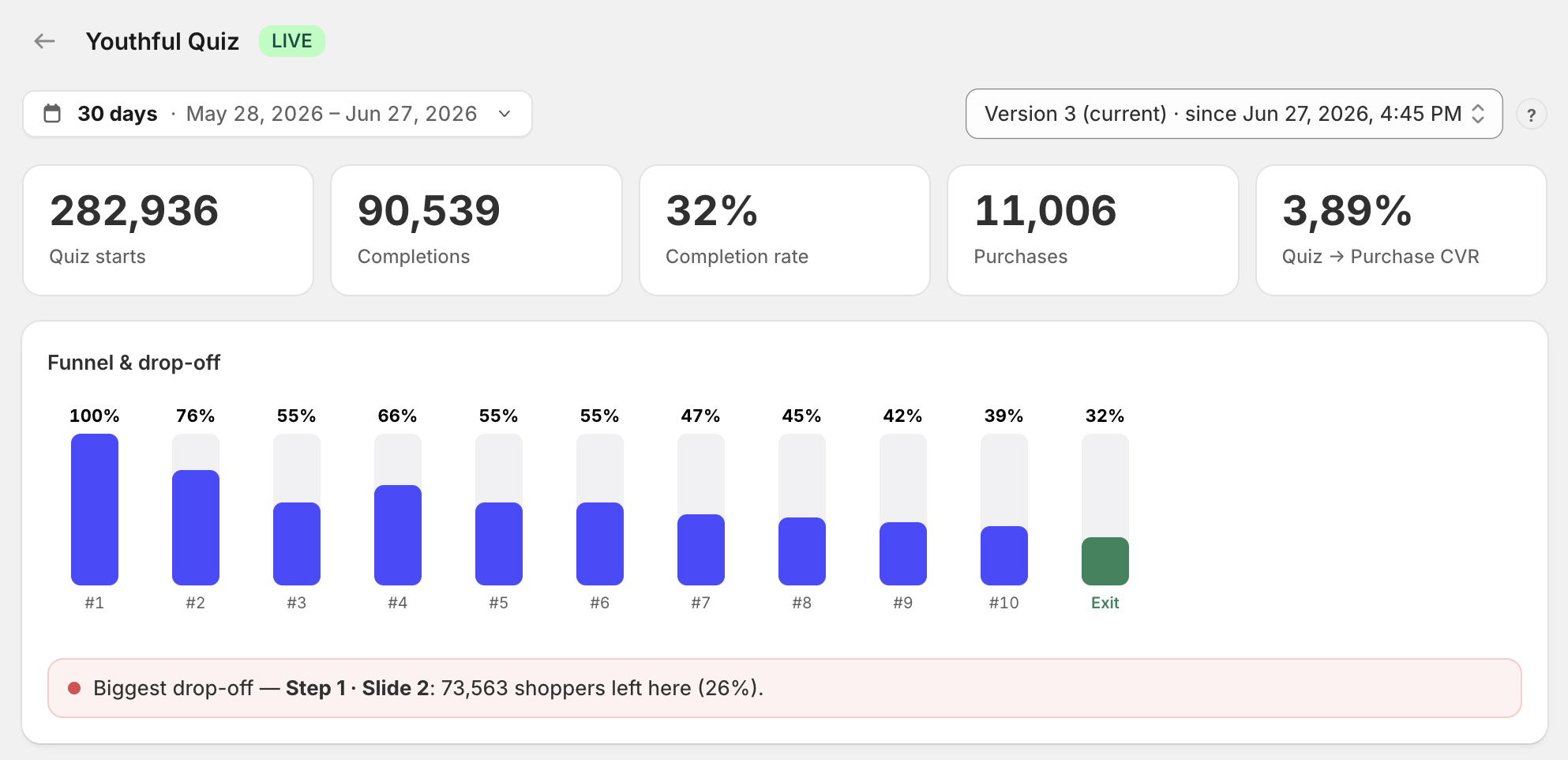
The antidote to launch-and-forget: the funnel view flags your biggest leak, so "improve the quiz" becomes one specific edit.
❓ Frequently asked questions
Which mistake costs the most?
Whichever one sits earliest in your funnel — early-stage leaks multiply through everything downstream. A weak first question costs you shoppers who'd have survived every later mistake. Diagnose in shopper order, fix in leak-size order.
How do I know which mistakes my quiz is making?
Three of them (grids, missing "because," hard-sell swerve) you can spot by taking your own quiz cold. The rest show up in per-question analytics — a cliff at a slide is a mistake with a street address.
Is it worth fixing an old quiz or should I rebuild?
Fix first. Most of these are one-slide edits, and the data tells you which slides. Rebuild only when the core logic — what maps to what — is wrong.
Can AI catch these for me?
A good chunk, yes. QuizLanding's assistant reads your quiz and its funnel data and flags the concrete issues — the leaking question, the weak hook — as an edit list rather than a report.
✅ The takeaway
Ten mistakes, four clusters: openings that ask too much, middles that waste taps, payoffs that dodge commitment, and operations flying blind. None of them requires talent to fix — just the checklist and the funnel view. Run your quiz through both this week; the usual result is two or three findings, each worth real money, each a one-slide edit.
The deeper guides: question writing, the result page, the email gate, and the metrics that catch all ten.
Want a quiz funnel live on your Shopify store this week? QuizLanding drafts your quiz with AI, hosts it natively on your store, and pairs full analytics with an AI assistant that tells you what to improve — all in one flat plan. Start for free.