
Quiz Funnels for Meta Ads: Making the Ad → Quiz → Offer Chain Hold
On Meta, your creative wins the attention and your funnel converts it — and the handoff between the two is where most accounts quietly bleed. A quiz funnel is one of the strongest landers you can put behind a Meta ad, because it can do something a static page can't: continue the ad's conversation instead of restarting it. But that only works if the chain — hook, first slide, questions, result, offer — actually holds. This is the media buyer's guide to making it hold.
🔗 One creative, two surfaces
The classic paid-social failure: an ad promises "find out why your sleep breaks at 3am," the click lands on a homepage, and the thread snaps. The shopper didn't click a brand — they clicked a question, and the page doesn't even acknowledge it.
A quiz funnel is built to catch that click. The ad opens a loop; the quiz is the loop closing, one tap at a time. Which means the first slide is really the last line of your ad:
- Ad hook: "Which of the 4 sleeper types are you?" → First slide: "Let's find out — how do you usually fall asleep?"
- Ad hook: "Most people underdose this ingredient." → First slide: "Quick check — what does your current routine look like?"
Write them together, in one document, as one arc. If the ad and the first slide were drafted in different tools by different people in different weeks, the seam will show.
🎬 Ad angles that set up a quiz
Some angles are built for a quiz lander, because their natural next step is answering questions:
- The typology hook. "Which skin type are you actually?" — identity curiosity that only a quiz can resolve. The result page pays it off with their type and their match.
- The misdiagnosis hook. "You've probably been treating the wrong problem." The quiz plays diagnostic: a few questions, then an honest read of their situation and what actually fits it.
- The overwhelm hook. "Forty options. Three questions. One answer." — aims the quiz directly at choice paralysis.
- The 60-seconds hook. A straightforward promise of a fast personalized answer. Unglamorous, durable.
Angles that don't set up a quiz: hard discount offers and retargeting reminders. Those clicks already know what they want — send them to a page, not a conversation. (The full decision framework is in quiz funnel vs. landing page.)
🎯 One angle, one quiz
Media buyers version their creative relentlessly, then send every variant to the same lander — and shrug when message match dies at the click. The fix: version the quiz with the creative.
Your typology angle gets a quiz whose first slide speaks typology. Your misdiagnosis angle gets one that opens diagnostically. Same core logic and products underneath; different opening slide, framing, and result copy on top.
This sounds like heavy ops. It isn't anymore — with QuizLanding you can clone a quiz and tweak the surface per angle, or hand AI your actual ad and have it draft the matching quiz from it.
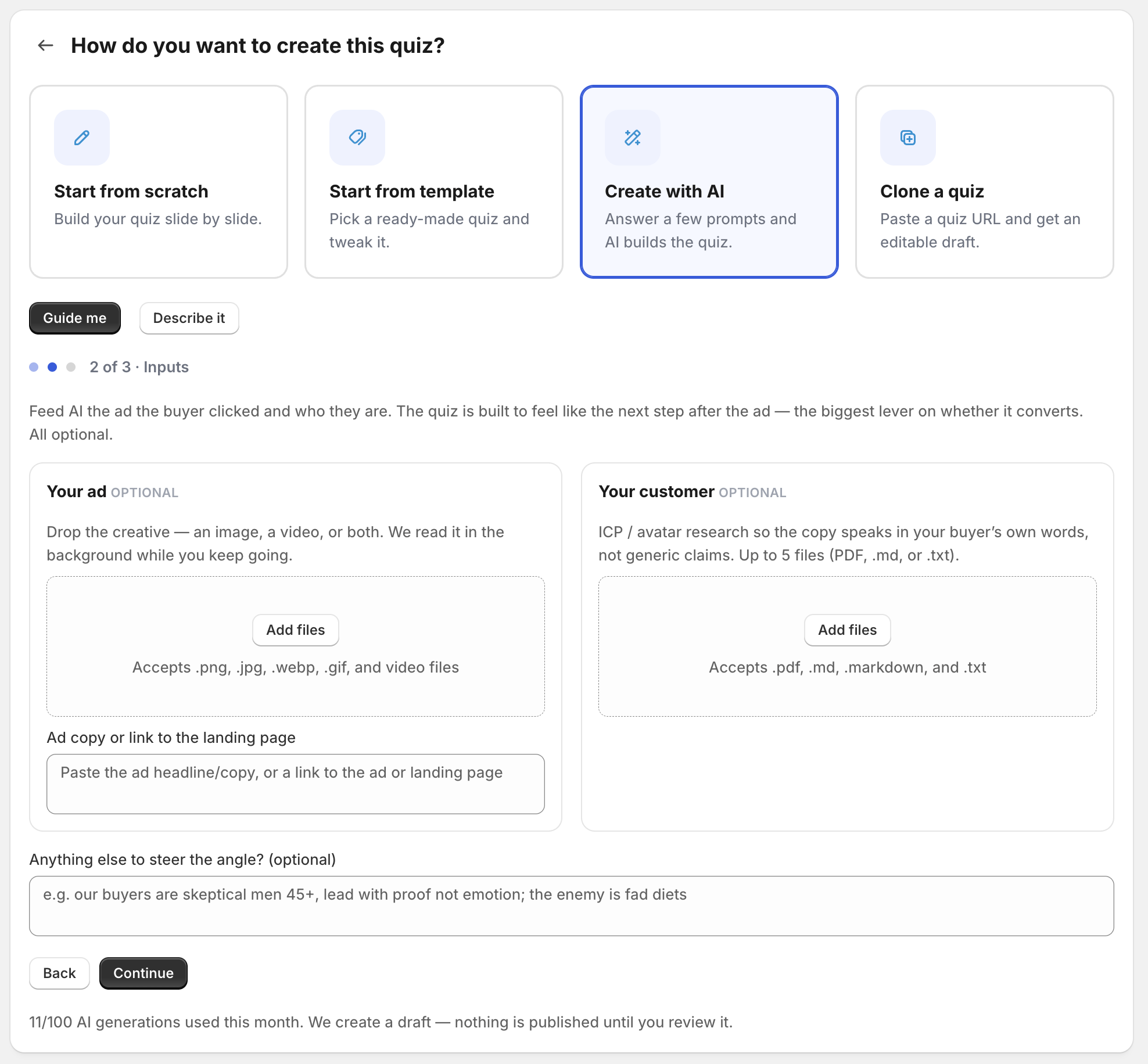
Feed the actual ad in, get a quiz drafted to match its promise — the fastest route to real message match per angle.
📉 The data side: what finishers hand you
Every quiz finisher gives you two things a pixel event can't:
- Zero-party data. Their problem, goal, and situation, in their own taps — volunteered, not inferred. That's segmentation fuel for your email flows and, in aggregate, a live report on which customer problems your traffic actually has. Media buyers read aggregate quiz answers like a survey of their own ad audience — because that's exactly what it is.
- A captured lead even without a sale. A click that doesn't buy today but finishes the quiz is not a wasted click — it's an email plus a full answer profile entering a personalized flow. That changes the math on what a "non-converting" click costs.
One infrastructure note: keep the quiz on your own domain. Native hosting means no mid-funnel domain hop for the shopper and your analytics events firing on your own store rather than a third-party's page.
🧪 Ad problem or funnel problem? The diagnosis
When ROAS on a quiz campaign disappoints, per-question data tells you which half of the chain broke — the single most valuable diagnostic in this whole setup:
| Symptom | Likely culprit | First fix |
|---|---|---|
| Weak start rate on the first slide | The ad → slide-one handoff | Rewrite slide one to continue the ad's exact promise |
| Drop-off spikes at one question | That question | Simplify it, move it later, or cut it |
| Strong completion, weak result-to-cart | The result page | Fix the hero, the "because," or the offer (guide) |
| Everything healthy, thin volume | The creative itself | Back to the ad account — the funnel isn't the bottleneck |
Without per-question visibility, all four of these look identical: "the campaign isn't working." With it, you know exactly where the money is leaking before you touch a thing.
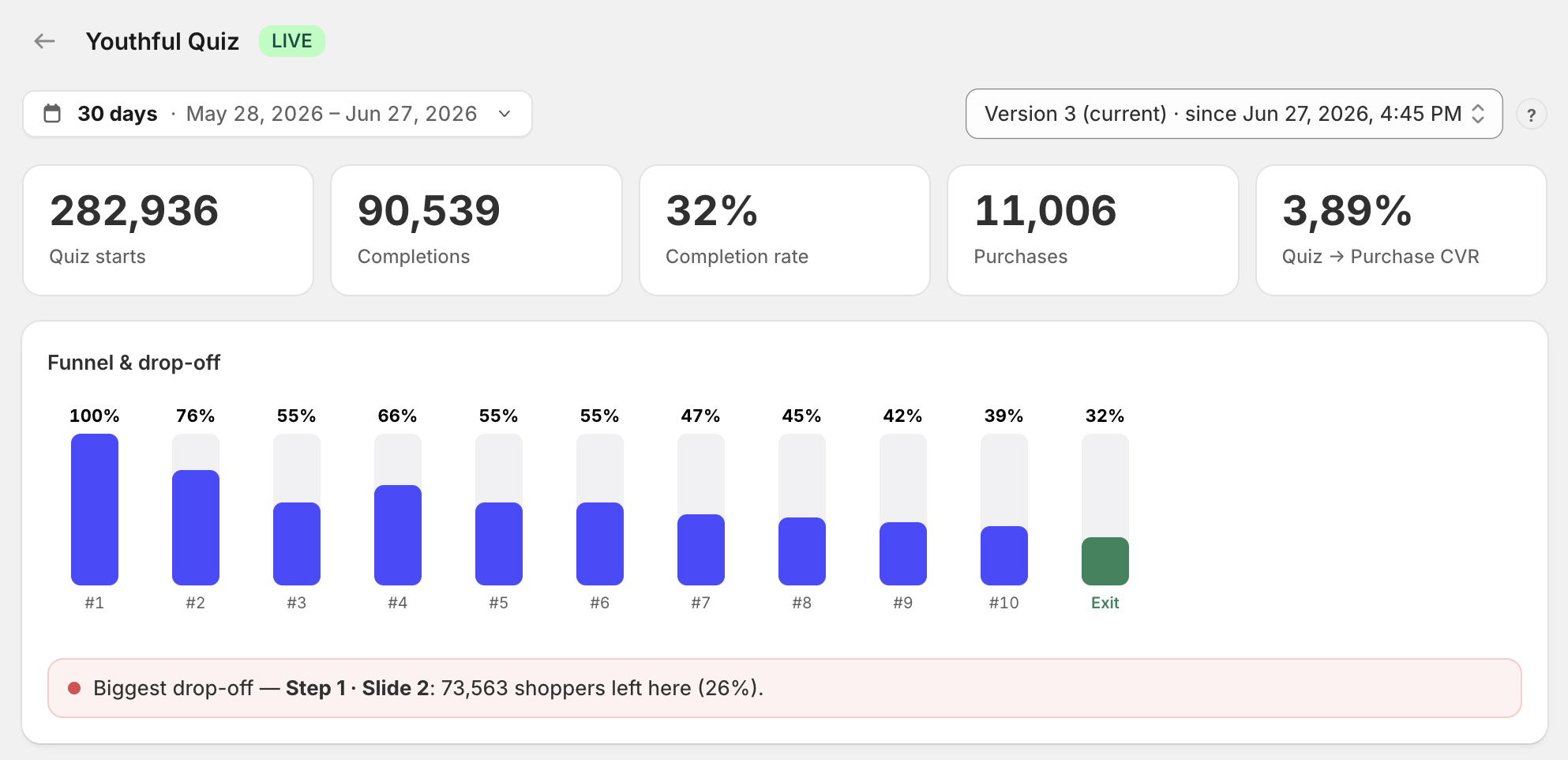
Per-question drop-off separates ad problems from funnel problems — the biggest leak is flagged for you.
❓ Frequently asked questions
Should I optimize the campaign for purchases or quiz completions?
Purchases, once volume allows — that's the event that pays. Quiz-step events are for your diagnosis, not necessarily for the algorithm's optimization target.
Does a quiz lander hurt my cost per purchase?
It shifts the funnel's shape: some shoppers drop at questions (visibly, fixably), while finishers arrive at the offer qualified and every finisher leaves data behind. Judge it on revenue per click including what the follow-up flows recover — not on the lander's raw conversion rate alone.
How many quiz variants should I run?
One per live creative angle — not per ad. Ten hook variations of the same angle can share a quiz; a genuinely different angle deserves its own opening.
Do quiz funnels work for TikTok or other paid channels?
The mechanics are identical: continue the hook, hold the thread, pay it off. Anywhere you buy attention with a promise, a quiz can be the surface that keeps it.
✅ The takeaway
A quiz funnel behind a Meta ad is one piece of creative living on two surfaces — write it that way. Match every angle with its own quiz opening, keep the whole chain on your domain, and let per-question drop-off referee the eternal "is it the ad or the lander?" argument with actual evidence. The buyers who win with quizzes aren't running better quizzes so much as tighter chains.
Go deeper: what is a quiz funnel, quiz funnel metrics, and the psychology of why this works on cold traffic.
Want a quiz funnel live on your Shopify store this week? QuizLanding drafts your quiz with AI, hosts it natively on your store, and pairs full analytics with an AI assistant that tells you what to improve — all in one flat plan. Start for free.