
Why Quiz Funnels Convert Cold Traffic: The Psychology, Explained
Quiz funnels aren't a gimmick that happens to work — they sit on top of some of the best-documented findings in behavioral science. Understanding why they convert matters for a practical reason: it tells you which parts of the format are load-bearing and which are decoration, so you optimize the right things. Here are the six principles doing the actual work, what the research really says about each, and how to use them without crossing into manipulation — because the same principles that convert honestly can be abused, and abused psychology refunds.
🫙 1. Choice overload — the problem the quiz exists to solve
In the classic field experiment by Sheena Iyengar and Mark Lepper (2000), a grocery display of 24 jams attracted more browsers than a display of 6 — but the smaller display produced roughly ten times the purchase rate. The abundant shelf was better at gathering a crowd and worse at closing anyone.
That's a DTC collection page in miniature: forty SKUs gather browsers who buy nothing. Later research showed the effect depends on context — choice overload bites hardest when options are hard to compare and the chooser lacks clear preferences. Which is exactly the state of a cold visitor on your store, and exactly what a quiz fixes: it doesn't shrink your catalog, it shrinks each shopper's decision to one confident answer.
🪜 2. Micro-commitments — small yeses compound
Robert Cialdini's commitment-and-consistency principle: once people take a small action, they're inclined to behave consistently with it. Every answered question is a small, voluntary act of participation — I'm the kind of person finding my match right now — and eight taps in, abandoning the process means contradicting eight of your own choices.
The honest version of this isn't a trap; it's genuine collaboration. The shopper co-authors the recommendation, so the recommendation arrives feeling partly theirs. That's why a quiz result gets a fundamentally different reception than the same product on a banner: one is a pitch, the other is a conclusion they helped reach.
📶 3. Endowed progress — started is hard to abandon
Nunes and Drèze (2006) ran the famous car-wash study: loyalty cards requiring 8 stamps but pre-stamped with 2 were completed far more often than cards requiring a plain 6 — same distance, but feeling underway changed behavior. People are measurably more motivated to finish what appears already begun.
Quiz applications: a progress bar, a first question so easy it's answered before the shopper "decided" to take a quiz, and framing like "2 of 6 — almost halfway." All honest, all structural, all working the same lever: momentum, once visible, protects itself.
⚙️ 4. The labor illusion — visible effort raises perceived value
Buell and Norton (2011) found that people value a service more when they can see it working — travel-site users preferred results that arrived after a visible "searching 30 airlines…" wait over identical results delivered instantly. Effort on the customer's behalf, made visible, increases perceived value.
This is why a brief "analyzing your answers…" beat before the result isn't fluff — it signals that the recommendation was computed for them, not preloaded for everyone. The line to hold: your analysis should be real. If every path lands on the same product with the same reason, no loading screen will save you — and a shopper who senses theater discounts everything after it.
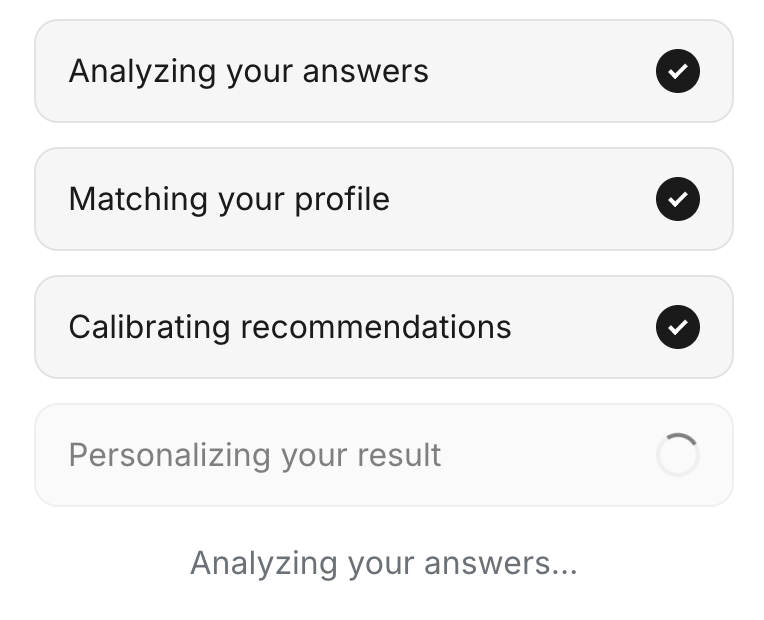
The analyzing beat, used honestly: real routing logic, made visible — which research says raises the value of what follows.
🪞 5. Self-relevance — the shopper's favorite subject
Psychology's self-reference effect (documented since Rogers, Kuiper & Kirker, 1977) shows people process and remember information dramatically better when it relates to themselves. A quiz is self-referential end to end: every question is about their skin, their sleep, their mornings — and the result page opens by reflecting their own words back.
Practically, this is why restating answers on the result page is non-negotiable, and why question copy written in the customer's language outperforms catalog-speak. The quiz's superpower is being about the shopper; generic copy anywhere in the chain squanders it.
🧲 6. The curiosity gap — a loop that demands closing
George Loewenstein's information-gap theory (1994) describes curiosity as the tension between what we know and what we want to know — a gap that motivates action until closed. A quiz hook manufactures precisely this gap: "Which sleeper type are you?" creates a question about yourself that you can't answer alone, and the only way to close it is through.
That gap powers the whole funnel — the ad opens it, each question narrows it, the result closes it — which is why ad-to-quiz message match matters so much: break the thread and you've left the loop dangling, and the shopper takes their unresolved curiosity elsewhere.
⚖️ The ethics line
Every principle above has a manipulative twin: fake analysis, rigged progress, manufactured anxiety, curiosity bait with no payoff. Beyond being wrong, the twins are bad business — direct response lives on the back end, and psychology that tricks a first purchase poisons the refund rate, the review page, and the repeat rate. The rule that keeps you clean: use these principles to deliver a genuinely better recommendation, never to disguise the absence of one. If your quiz logic is real, every technique here is just good interface design for honest advice.
❓ Frequently asked questions
Is this why quizzes work better on cold traffic than warm?
Largely, yes. Warm visitors already know what they want — reduction, commitment, and curiosity have less to do. Cold visitors arrive with no preferences and full choice overload, which is the exact condition these principles treat.
Which principle should I optimize first?
Choice reduction — it's the foundation. A quiz that ends in one confident, well-justified recommendation gets most of the value even with a plain interface. Progress bars and analyzing beats are multipliers on a working core, not substitutes for one.
Do shoppers know these techniques are being used?
Increasingly, yes — and it doesn't matter, in the same way knowing why a good salesperson's questions work doesn't make their recommendation worse. What shoppers punish isn't psychology; it's dishonesty.
Where can I see if my quiz is actually landing these principles?
In the numbers: per-question drop-off shows where momentum dies, and result-to-cart shows whether the payoff feels earned. The metrics guide maps each number to its fix.
✅ The takeaway
Quiz funnels convert because they're built from real behavioral science: shrink the decision, let small yeses compound, make progress and effort visible, keep everything about the shopper, and close the loop you opened. None of it is exotic and none of it requires tricks — the research favors the honest version, where every principle serves an actually-good recommendation. Build that, and the psychology takes care of itself.
Put it into practice: what is a quiz funnel, writing questions that convert, and the result page anatomy.
Want a quiz funnel live on your Shopify store this week? QuizLanding drafts your quiz with AI, hosts it natively on your store, and pairs full analytics with an AI assistant that tells you what to improve — all in one flat plan. Start for free.