
How to Write Quiz Questions That Convert: A Direct Response Guide
Here's the reframe that changes how you build quizzes: every question is sales copy. Not a form field, not a survey item — a line of direct response copy whose job is to keep the shopper moving and set up the sale at the end. The brands whose quizzes convert write questions the way they write ads: every one earns the next tap, speaks the customer's language, and quietly builds the case for the recommendation.
✍️ A question's two jobs
Every question in a converting quiz does at least one of these:
- Routing — the answer changes which product (or variant, or bundle) the shopper ends up with.
- Case-building — the answer becomes part of the reason on the result page: "Because you told us you have oily skin and spend most days outdoors…"
A question that does neither is a leak. It costs you a tap's worth of completions and pays nothing back. The fastest way to improve most quizzes is deleting a question, not adding one.
🥇 The first question rule
The first question has exactly one job: get the second question answered. Not to gather your most important data point — to start momentum.
That means:
- Easy — answerable in under two seconds, no self-reflection required.
- Visual — image options beat text lists on mobile.
- Zero-stakes — nothing personal, nothing that feels like commitment.
"What's your budget?" as question one is a hand in the shopper's pocket before you've said hello. "Which of these sounds most like your mornings?" with four images is an invitation. Save the higher-effort questions for the middle, once tapping has become a habit.
🗣️ Customer language, not catalog language
Shoppers know their problem; they don't know your SKUs, your ingredient names, or your internal categories.
| Catalog language ❌ | Customer language ✅ |
|---|---|
| "Which formulation do you prefer?" | "How does your skin feel by mid-afternoon?" |
| "Select your roast profile" | "How do you take your coffee most mornings?" |
| "Choose your tension level" | "How do you usually sleep — side, back, or a bit of everything?" |
| "What's your target macro split?" | "What's the goal — more energy, more muscle, or better recovery?" |
The pattern: ask about their life, and let your logic translate the answer into a product. That translation is your job, not theirs — it's the whole reason the quiz exists.
📏 How many questions?
Three to eight for almost every DTC use case. But the honest rule isn't a number — it's the two-jobs test above. A five-question quiz where every answer routes or builds the case beats a three-question quiz with one dead question in it.
When you're tempted to add a "nice to know" question for your own research: that data costs you finishers. Put it in a post-purchase survey instead, where it's free.
🎨 Formats that keep momentum
Twenty identical multiple-choice screens feel like a form. Varying the interaction keeps the experience feeling alive — and different formats suit different questions:
- Image picks for anything visual — styles, rooms, looks, vibes.
- Swipe (this or that) for fast preference-mapping — several data points in seconds.
- Pick-a-card for playful, identity-flavored questions.
- Sliders or scales for intensity — "How sensitive is your skin?"
- An "analyzing your answers" moment before the result — a brief beat that signals real work is happening on their behalf. (There's genuine research behind why visible effort increases perceived value — see the psychology guide.)
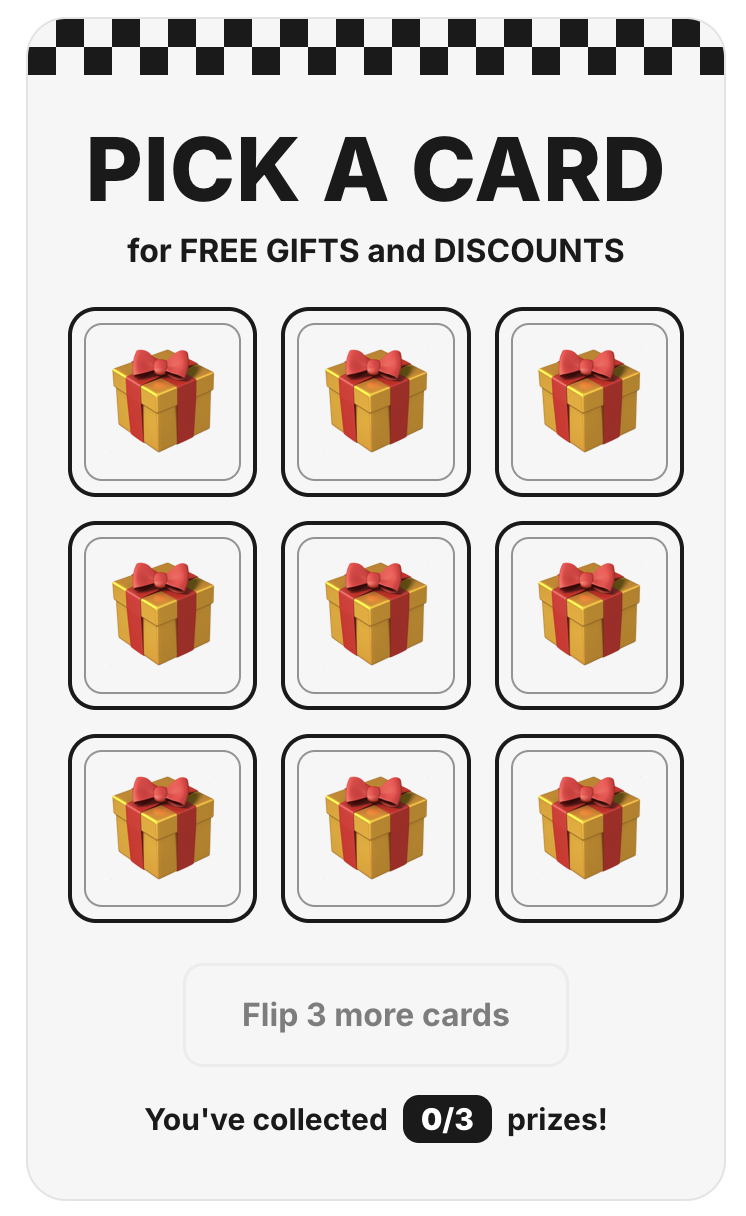
Interaction variety is momentum. Pre-made blocks like pick-a-card and swipe keep taps feeling fresh instead of form-like.
🧠 Questions that sell while they ask
The best direct response quizzes use the middle questions to seed the sale — honestly. Two techniques:
Seed the problem's cost. "How long have you been dealing with this?" doesn't just gather data — it has the shopper articulate, in their own head, that the problem is ongoing and unsolved. Their answer does work no headline could.
Build the "because" ledger. Every answer is a line item the result page will reference: you said X, you told us Y, so we matched you with Z. Write questions knowing which answers you'll quote back. A result page that mirrors the shopper's own words feels like advice; one that ignores them feels like a pitch with extra steps. (More in the result page guide.)
One boundary, because honest marketing is the whole game: seed real problems your product genuinely addresses. Manufacturing anxiety the product can't resolve converts once and refunds twice.
🚫 Questions to cut
- The disguised form field. "What's your age bracket?" with no routing consequence. If it doesn't change anything, it's surveillance, and shoppers feel it.
- The double-barrel. "What's your skin type and main concern?" — two questions wearing one question's coat. Split it or pick one.
- The expertise test. Anything the shopper might get wrong. The quiz should never make someone feel uninformed about your own product category.
- The stall. Open-text boxes mid-quiz. Typing on mobile is where momentum goes to die — keep free text out of the main path.
- The premature gate. Asking for the email before you've built any value. The gate deserves its own strategy — we wrote it up here.
❓ Frequently asked questions
Should questions be funny or on-brand quirky?
Personality helps if it's genuinely your brand voice — but clarity converts and cleverness doesn't. If a joke costs comprehension, cut the joke.
How do I know which question is losing people?
Per-question drop-off analytics. It's the single most actionable number in the whole funnel — it converts "the quiz underperforms" into "question four is the leak." QuizLanding shows this per slide and flags the biggest leak for you.
Can AI write my questions?
AI is a strong first-draft tool — QuizLanding drafts the full question set, logic, and result page from a description of your store or even from one of your ads. Treat the draft as a working hypothesis, then let drop-off data drive the edits.
Should every path lead to a different product?
Not necessarily different products — but different reasons. Two shoppers can land on the same hero product with completely different "because" paragraphs, and both feel personally matched.
✅ The takeaway
Write questions like the ad copy they are: easy first tap, customer's language, no dead weight, formats that keep thumbs moving, and every answer either routing the shopper or building the "because" your result page will cash in. Then watch per-question drop-off and edit like a direct response marketer — because that's what quiz question writing is.
Keep going: the result page guide, quiz funnel metrics, and the mistakes that kill conversion.
Want a quiz funnel live on your Shopify store this week? QuizLanding drafts your quiz with AI, hosts it natively on your store, and pairs full analytics with an AI assistant that tells you what to improve — all in one flat plan. Start for free.